Mirza Ghalib is not just a poet — he is a feeling. His words have survived centuries, crossed borders, and touched hearts in every corner of the world. If you have ever felt the ache of unrequited love, the bittersweet joy of longing, or the strange comfort found in sadness, then you have already lived inside a Ghalib verse. In 2026, as the world moves faster than ever, people are still searching for words that understand them — and they keep finding those words in Ghalib’s poetry.
This article is a carefully curated collection of the Best Mirza Ghalib Love Shayari in English in 2026, presented with original Urdu text, Roman Urdu transliterations, English translations, and deep explanations. Whether you are a longtime admirer of Urdu literature or someone just discovering Ghalib for the first time, these shayaris will speak to you in a language older and deeper than any spoken tongue — the language of the heart.
From the pain of separation to the wisdom buried inside heartbreak, from silent longing to the madness of love, this collection covers the full spectrum of Ghalib’s romantic genius. Read on, feel deeply, and let Ghalib show you why love, in all its beautiful suffering, is the most human experience of all.
Introduction: Mirza Ghalib Love Shayari
Mirza Asadullah Baig Khan, known to the world as Ghalib, was born in Agra in 1797 and lived until 1869. He wrote primarily in Urdu and Persian, and his ghazals are considered among the finest literary achievements in South Asian history. But what made Ghalib extraordinary was not just his technical brilliance — it was his fearless honesty about human emotion, especially love.
Ghalib’s love poetry is not the kind that simply praises the beauty of the beloved. It digs deeper — into the pain of not being loved back, into the dignity of a lover who suffers but does not beg, into the philosophical questions that love raises about existence itself. He wrote about love the way a philosopher thinks about God — with reverence, confusion, yearning, and a kind of glorious despair.
In today’s social media-driven world, Ghalib’s shayaris are shared millions of times across Instagram, WhatsApp, and Twitter. His two-line verses — known as she’rs — have become the go-to expression for every heartbroken soul. Yet most people only know a handful of his verses. This article goes deeper, presenting some of the finest and most emotionally resonant love shayaris from Ghalib’s divan, translated and explained for the modern reader.
Understanding Mirza Ghalib’s Love Poetry
To truly appreciate Ghalib’s love poetry, one must understand the world he inhabited. He lived in Mughal Delhi during its decline, watched empires fall, experienced personal grief and financial hardship, and yet produced verse after verse of unmatched beauty. His personal life was marked by unrequited attachments, a complicated marriage, and a deep philosophical restlessness.
His poetry reflects all of this. Love for Ghalib was never simple. It was an entire universe — painful and beautiful, hopeful and hopeless, rational and mad all at once. He used the classical Urdu ghazal form masterfully, a form where each couplet (she’r) is an independent unit of meaning, yet all couplets in a poem are connected by a shared rhyme scheme (radif and qafia).
What sets Ghalib apart from other Urdu poets of his era is his use of paradox, irony, and self-aware wit. He could write about his own suffering with a kind of amused detachment that made his pain feel both intensely personal and universally relatable. His lover is always aware, always thinking, never simply swept away without understanding what is happening to him.
Understanding these elements helps the reader grasp not just what Ghalib said, but why it still resonates so powerfully — in every culture, in every era, in every heart that has ever loved.
What Makes Ghalib’s Love Poetry Unique
Many poets have written about love. But few have done so with Ghalib’s combination of intellectual depth, emotional rawness, and linguistic mastery. Here is what makes his love poetry truly one of a kind:
First, Ghalib refuses to idealize love without acknowledging its suffering. He does not pretend that love is always joyful or that the beloved is always kind. He writes honestly about the cruelty of the beloved, the humiliation of the lover, and the strange addiction that keeps one returning despite all pain.
Second, his imagery is startlingly original. He does not rely on tired metaphors. Instead, he creates entirely new ways of expressing familiar emotions — comparing the heart to a battlefield, love to a wound that one cherishes, and silence to a language more eloquent than words.
Third, Ghalib is self-aware in a way that feels remarkably modern. He knows he is suffering, he knows it might be irrational, and yet he embraces it anyway. This philosophical acceptance of love’s madness gives his poetry a wisdom that goes beyond mere emotion.
Finally, his language itself is a kind of music. Even in translation, the rhythm of his thought has a cadence that feels natural, inevitable, and deeply human.
1. The Pain of Separation
Urdu:
ہزاروں خواہشیں ایسی کہ ہر خواہش پہ دم نکلے
بہت نکلے مرے ارمان لیکن پھر بھی کم نکلے
Transliteration:
Hazaron khwahishein aisi ke har khwahish pe dum nikle
Bahut nikle mere armaan lekin phir bhi kam nikle
Translation:
I have thousands of desires, each one worth dying for
Many of my longings were fulfilled, yet they still felt too few
Explanation:
This is perhaps Ghalib’s most famous opening couplet. It captures the insatiable nature of love’s longing — the lover has countless desires, each so intense it feels life-threatening. Yet even when some desires are fulfilled, the hunger is never satisfied. It speaks to the way love always wants more, the way fulfillment in love only deepens the yearning rather than ending it.
For the modern reader, this verse resonates as a description of the emotional intensity that comes with deep love — where one fulfilled wish only reveals a hundred more waiting beneath the surface.
2. Love’s Madness
Urdu:
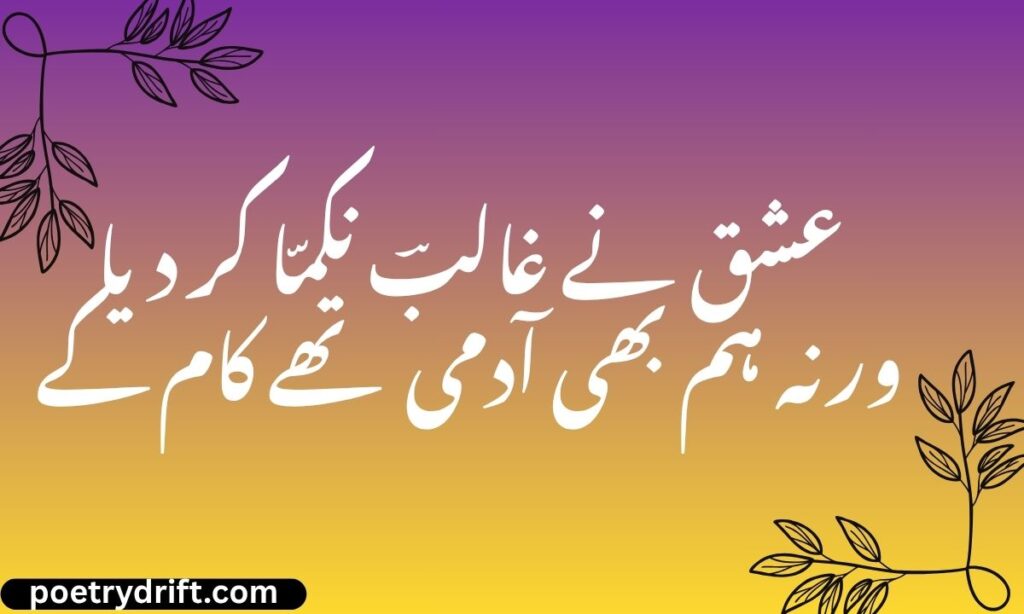
عشق نے غالبؔ نکمّا کر دیا
ورنہ ہم بھی آدمی تھے کام کے
Transliteration:
Ishq ne Ghalib nikamma kar diya
Warna hum bhi aadmi the kaam ke
Translation:
Love has made me utterly useless, O Ghalib
Otherwise, I too was once a man of purpose
Explanation:
This couplet is written with Ghalib’s signature self-deprecating humor and honesty. He blames love for ruining his productivity, his purpose, and his sense of a useful life. But there is no real regret here — the tone is almost fond, as if he is describing a beloved disease he would not trade for health.
It captures how love can completely reorganize a person’s priorities, making everything that once seemed important feel trivial. This verse is deeply relatable for anyone who has ever lost themselves in love.
3. The Beloved’s Indifference
Urdu:
ہم نے مانا کہ تغافل نہ کرو گے لیکن
خاک ہو جائیں گے ہم تم کو خبر ہونے تک
Transliteration:
Hum ne maana ke taghaful na karoge lekin
Khaak ho jaayenge hum tum ko khabar hone tak
Translation:
I accept that you will not ignore me forever, but
I shall turn to dust before the news reaches you
Explanation:
This verse is a masterclass in ironic resignation. The lover generously believes in the beloved’s eventual awareness — acknowledging that the beloved is not cruel by nature, only slow to notice. But the cruelly honest punchline is that by the time awareness arrives, the lover will have perished from waiting.
It is a verse about the brutal mathematics of love — where time, indifference, and longing combine in a way that makes even hope feel fatal. Ghalib manages to be both forgiving of the beloved and devastatingly honest about the consequences of being loved too late.
4. Love’s Wound
Urdu:
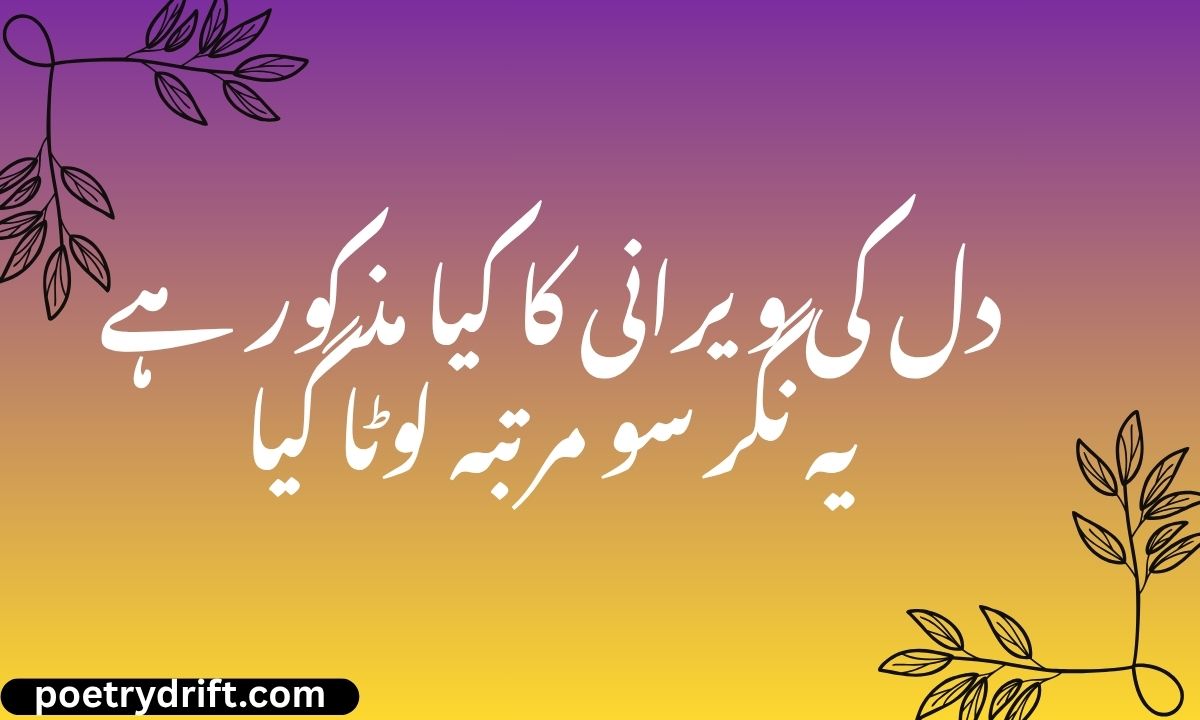
دل ناداں تجھے ہوا کیا ہے
آخر اس درد کی دوا کیا ہے
Transliteration:
Dil naadan tujhe hua kya hai
Aakhir is dard ki dawa kya hai
Translation:
O innocent heart, what has happened to you
After all, what is the cure for this pain
Explanation:
Here Ghalib addresses his own heart with a gentle, almost parental concern. He calls it ‘naadan’ — innocent, naive — as if the heart is a child that wandered into danger without understanding. The question ‘what is the cure?’ is not really a question; it is a lament. Ghalib knows there is no cure. The heart fell in love and now must live with it.
This verse is especially touching because of how it humanizes the experience of heartbreak — not as weakness, but as the inevitable consequence of having a heart that feels too deeply.
5. The Beauty of Pain
Urdu:
رنج سے خوگر ہوا انسان تو مٹ جاتا ہے رنج
مشکلیں مجھ پر پڑیں اتنی کہ آساں ہو گئیں
Transliteration:
Ranj se khoogar hua insaan to mit jaata hai ranj
Mushkilein mujh par padin itni ke aasaan ho gayin
Translation:
When a person grows accustomed to sorrow, the sorrow itself disappears
So many hardships fell upon me that they became easy
Explanation:
This verse reveals Ghalib’s philosophical acceptance of suffering as a transformative force. Rather than lamenting endless pain, he celebrates the strange alchemy that turns unbearable suffering into something manageable — even familiar. The lover who has suffered enough finds that suffering itself loses its power.
It is a verse about resilience written with beauty. It suggests that the deepest form of strength is not the absence of pain, but such intimacy with pain that it no longer frightens you.
Also Read This: Friendship Poetry in Urdu – 2 Lines Dosti Poetry for Best Friends
6. Presence in Absence
Urdu:
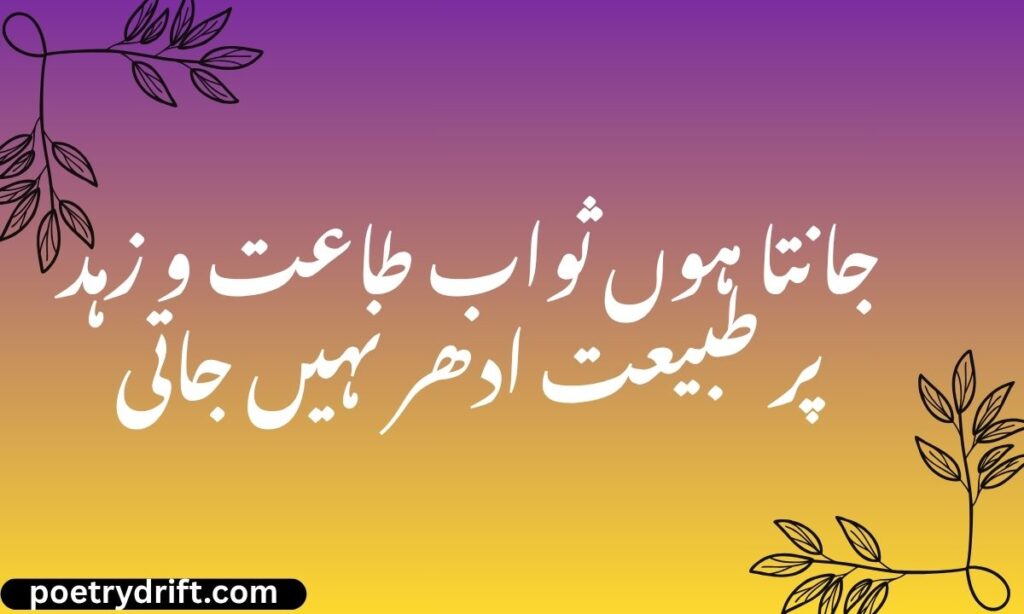
جانتا ہوں ثواب طاعت و زہد
پر طبیعت ادھر نہیں جاتی
Transliteration:
Jaanta hoon sawaab taa’at o zuhd
Par tabiyat idhar nahin jaati
Translation:
I know the rewards of piety and devotion
But my nature simply does not go that way
Explanation:
In this verse, Ghalib confesses with characteristic honesty that he understands virtue and knows its rewards — but his nature pulls him elsewhere. Read in the context of love, this is the lover who knows he should walk away, knows the sensible path, but cannot help following the heart’s irrational pull toward the beloved.
It speaks to the way love bypasses reason entirely, making wisdom feel irrelevant in the face of desire. Ghalib captures the human experience of knowing better and still choosing differently — and there is no apology in his tone, only honest acknowledgment.
7. The Language of Silence
Urdu:
تھی خبر گرم کہ غالبؔ کے اڑیں گے پرزے
دیکھنے ہم بھی گئے تھے پہ تماشا نہ ہوا
Transliteration:
Thi khabar garm ke Ghalib ke udenge purze
Dekhne hum bhi gaye the pe tamaasha na hua
Translation:
Word had spread that Ghalib would be torn to pieces
I too went to watch, but the spectacle never came
Explanation:
This verse is written with Ghalib’s remarkable ability to observe himself from the outside with amused distance. He writes as if he himself went to watch his own destruction — a spectator of his own suffering. The dark humor is unmistakable: even his predicted ruin failed to arrive on time.
In the context of love, this verse speaks to how the lover braces for total destruction — and then keeps surviving, kept alive by nothing but the strange endurance of the heart. It is both comic and deeply moving.
8. Love’s Contradiction
Urdu:
محبت میں نہیں ہے فرق جینے اور مرنے کا
اسی کو دیکھ کر جیتے ہیں جس کافر پہ دم نکلے
Transliteration:
Muhabbat mein nahin hai farq jeene aur marne ka
Usi ko dekh kar jeete hain jis kaafir pe dum nikle
Translation:
In love, there is no difference between living and dying
We live by looking at the very one whose sight could kill us
Explanation:
This is one of Ghalib’s most powerful paradoxical statements about love. He collapses the distinction between life and death in love, declaring them equivalent. And then he reveals the central contradiction of a lover’s existence: the beloved who kills is also the one who gives life.
It is a profound insight into the experience of intense love — where the object of love is simultaneously the greatest source of joy and the greatest source of pain, where seeing the beloved is both living and dying at once.
9. The Burden of Hope
Urdu:
قید حیات و بند غم، اصل میں دونوں ایک ہیں
موت سے پہلے آدمی غم سے نجات پائے کیوں
Transliteration:
Qaid-e-hayaat o band-e-gham, asl mein dono ek hain
Maut se pehle aadmi gham se nijaat paaye kyun
Translation:
The prison of life and the chains of grief are essentially one
Why should a person be freed from sorrow before death
Explanation:
This verse presents one of Ghalib’s most philosophical statements about the nature of existence itself. He equates being alive with being in sorrow — suggesting that life and grief are not separate experiences but one continuous condition. The question at the end is not cynical; it is almost logical within Ghalib’s philosophical framework.
In the context of love, this verse suggests that the pain of loving is not an accident or a misfortune — it is woven into the very fabric of a life lived fully. To love is to grieve; to be alive is to be in chains. And Ghalib seems to find a strange peace in this acceptance.
10. The Gift of Pain
Urdu:
غم اگرچہ جان گسل ہے پر کہاں جائیں کہ دل
ہے مگر ایسی جگہ پر آستاں جس کو ترا
Transliteration:
Gham agarche jaan-gusl hai par kahaan jaayein ke dil
Hai magar aisi jagah par aastaan jis ko tera
Translation:
Although grief is life-draining, where shall we go, for the heart
Has made its home at a threshold that belongs to you
Explanation:
This verse captures the helplessness of being in love — where even knowing that this love is destroying you, you cannot leave, because the heart has already made the beloved’s doorstep its permanent home. The image of the ‘aastaan’ — the threshold — is particularly evocative. The lover does not even enter the beloved’s house; he merely lives at the door. And yet, that is enough. That is home.
It is a verse about the way love creates its own geography — and how, once love has mapped the beloved as home, no other place feels inhabitable, even when staying is painful.
11. The Nature of Desire
Urdu:
آہ کو چاہیے اک عمر اثر ہونے تک
کون جیتا ہے تری زلف کے سر ہونے تک
Transliteration:
Aah ko chaahiye ik umr asar hone tak
Kaun jeeta hai teri zulf ke sar hone tak
Translation:
A sigh needs a lifetime to have its effect
Who survives long enough to see your hair untangled
Explanation:
This couplet uses two timescales to speak about love’s endless waiting. The ‘aah’ — the sigh of the lover — takes a lifetime to reach its destination and have an effect. And the ‘zulf’ — the beloved’s tress — is famously the symbol of something tangled, complex, and beautiful. To see it ‘untangled’ means to finally reach the beloved, to have love completed and fulfilled. But who lives long enough for that?
It is a meditation on how love operates on a time scale that exceeds a human life — making the lover’s entire existence feel too brief for the depths of what is felt.
12. Love’s Revelation
Urdu:
نہ گل نغمہ ہو نہ پردہ ساز ہو
میری سخن سنجی فقط گوئی بیاں میں ذکر مضموں تازہ ہے
Transliteration:
Na gul naghma ho na parda saaz ho meri sukhan sanji
Faqat gooyi bayaan mein zikr mazmoon taaza hai
Translation:
My poetry-making requires neither flowery melody nor musical instruments
Only in plain expression, the subject matter remains fresh
Explanation:
This verse shows Ghalib’s literary philosophy as a statement about authentic expression in love. He claims to need no artificial embellishments — flowery language or musical accompaniment — because the subject itself, love’s experience, is powerful enough on its own.
This is Ghalib asserting the value of sincere, direct expression over ornamental poetry. Real feeling needs no decoration. The beloved’s impact is so profound that describing it truthfully creates powerful poetry. It is a remarkably modern poetic stance — prioritizing authentic emotion and original insight over traditional ornamentation.
13. The Eternal Wait
Urdu:
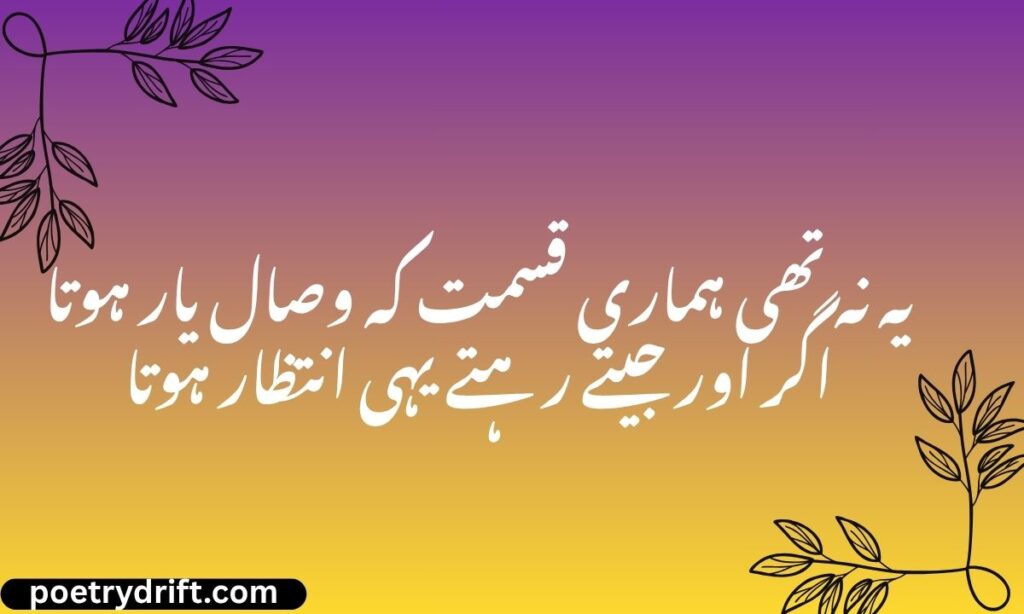
یہ نہ تھی ہماری قسمت کہ وصال یار ہوتا
اگر اور جیتے رہتے یہی انتظار ہوتا
Transliteration:
Yeh na thi hamari qismat ke wisaal-e-yaar hota
Agar aur jeete rehte yahi intezaar hota
Translation:
It was not my fate to be united with my beloved
Had I lived longer, this waiting would have continued all the same
Explanation:
Few verses in all of Urdu literature capture the despair of unrequited love as perfectly as this one. Ghalib accepts with devastating calm that union was never meant to be — not because circumstances were against him, but because fate had simply not written it. And then, with heartbreaking logic, he adds: more life would not have helped. It would have simply been more waiting.
The verse redefines hope itself: not as something that would eventually be rewarded, but as an eternal condition of love — a state of permanent yearning that is its own kind of existence. To wait is to love. To love is to wait. There is no end.
14. Love’s Wisdom
Urdu:
عشق پر زور نہیں ہے یہ وہ آتش غالبؔ
کہ لگائے نہ لگے اور بجھائے نہ بنے
Transliteration:
Ishq par zor nahin hai yeh woh aatish Ghalib
Ke lagaaye na lage aur bujhaaye na bane
Translation:
One has no power over love, it is that kind of fire, O Ghalib
That cannot be lit by force, and once lit, cannot be extinguished
Explanation:
This verse is Ghalib’s definitive statement on the nature of love itself. Love cannot be commanded into existence — you cannot force yourself to fall in love. And once love is present, it cannot be extinguished by will either. It is the most honest description of love’s involuntary nature ever written.
The metaphor of fire is perfect: fire does not obey instructions. It starts when conditions are right and refuses to go out until it has consumed what it must. Love, Ghalib tells us, operates by its own laws, indifferent to human will or reason. This wisdom, expressed in two lines, contains what many poets have taken volumes to say.
The Timeless Appeal of Urdu Shayari Love
Urdu shayari has a unique quality that very few literary traditions in the world can match: it makes suffering beautiful. This is not a glorification of pain for its own sake, but rather an acknowledgment that pain, when felt deeply and expressed honestly, reveals truths about the human condition that joy cannot. Ghalib understood this better than anyone.
The ghazal form itself — with its independent couplets linked by rhyme and refrain — mirrors the disconnected, fragmented nature of love. Love does not follow a logical narrative. It is a series of moments, flashes of feeling, sudden revelations, and silences. The ghazal captures this perfectly.
In 2026, Urdu shayari is experiencing a remarkable global renaissance. Young people from South Asia and its diaspora are rediscovering their literary heritage. Non-Urdu speakers are accessing translations and finding that Ghalib’s words speak directly to their own experiences. Streaming platforms, social media, and digital publishing have made Ghalib more accessible than ever before.
What keeps Urdu shayari love poetry alive is not nostalgia — it is relevance. The questions Ghalib asked about love, desire, and heartbreak are the same questions people ask today. Technology changes. Languages evolve. Empires rise and fall. But the human heart remains stubbornly, beautifully the same.
Heart Touching Mirza Ghalib Shayari in English
کوئی صورت نظر نہیں آتی
Koi umeed bar nahin aati
Koi soorat nazar nahin aati
No hope comes to fruition
No path forward can be seen
درد منت کش دوا نہ ہوا
میں نہ اچھا ہوا برا نہ ہوا
Dard minnat-kash-e-dawa na hua
Main na achha hua bura na hua
My pain did not bow to any cure
I neither recovered nor worsened
بازیچہ اطفال ہے دنیا مرے آگے
ہوتا ہے شب و روز تماشا مرے آگے
Baazeeche-e-atfaal hai duniya mere aage
Hota hai shab o roz tamaasha mere aage
The world is a children’s playground before me
Day and night a spectacle unfolds before my eyes
نکلنا خلد سے آدم کا سنتے آئے ہیں لیکن
بہت بے آبرو ہو کر تیرے کوچے سے ہم نکلے
Nikalna khuld se Adam ka sunte aaye hain lekin
Bahut be-aabroo ho kar tere kuuche se hum nikle
We had heard of Adam’s expulsion from paradise
But how shamefully dishonored I left your alley
Understanding Ghalib’s Common Themes in Love Poetry
Ghalib’s love poetry revolves around several recurring themes that form the architecture of his emotional universe. Understanding these themes helps readers go beyond the surface beauty of his words and grasp the deeper philosophical landscape he was mapping.
The first and most dominant theme is separation (hijr). In the classical Urdu poetic tradition, the beloved is always absent — either physically unavailable or emotionally distant. Ghalib elevated this theme to a philosophical principle: separation is not merely a condition; it is the natural state of the lover. To love is to be separated. Even when physically present, the lover is existentially alone with his love.
The second major theme is the cruelty of the beloved (sitam-e-yaar). The beloved in Ghalib’s poetry is often indifferent, capricious, and even cruel. But Ghalib never condemns the beloved for this. Instead, he finds a strange nobility in loving despite cruelty — suggesting that real love does not require kindness in return.
The third theme is the philosophy of suffering itself. Ghalib transforms pain from a problem to be solved into a condition to be understood and even embraced. His verses suggest that suffering in love is not something that happens to the lover — it is something the lover chooses, because the alternative (not loving) is a lesser form of existence.
Finally, there is the theme of self-awareness. Unlike many poets who lose themselves entirely in emotion, Ghalib always retains a watching, thinking part of himself. He observes his own suffering with curiosity and occasional dark humor. This gives his poetry a quality of wisdom that transcends mere emotional expression.
Mirza Ghalib Shayari in English 2 Lines
ہوئی مدت کہ غالبؔ مر گیا پر یاد آتا ہے
وہ ہر اک بات پر کہنا کہ یوں ہوتا تو کیا ہوتا
Hui muddat ke Ghalib mar gaya par yaad aata hai
Woh har ik baat pe kehna ke yun hota to kya hota
It has been long since Ghalib died, yet I still remember
How he would say at every turn: if it had been this way, what then
کب سے ہوں کیا بتاوں جہان خراب میں
شب ہائے ہجر کو بھی رکھوں گر حساب میں
Kab se hoon kya bataoon jahaan-e-kharaab mein
Shab-haye hijr ko bhi rakhuun gar hisaab mein
How long have I been in this ruined world, what can I say
If I were to count the nights of separation too
وہ فراق اور وہ وصال کہاں
وہ شب و روز و ماہ و سال کہاں
Woh firaaq aur woh wisaal kahaan
Woh shab o roz o maah o saal kahaan
Where are those days of separation and union
Where are those nights and days, those months and years
جو یہ کہو کہ کیوں ہو غمگین
تو کیا جواب دوں کیا کیا ہوا ہے مجھ کو
Jo yeh kaho ke kyun ho ghamgeen
To kya jawaab doon kya kya hua hai mujhko
If you ask why I am so grief-stricken
What answer shall I give for all that has happened to me
Why Ghalib’s Love Poetry Remains Relevant Today
In an age where communication has been reduced to emojis and disappearing stories, Ghalib’s poetry offers something rare: depth. His words do not simplify emotion — they honor its full complexity. In a world where love is often discussed as something to be achieved or optimized, Ghalib reminds us that love is something to be felt, suffered, wondered at, and ultimately accepted on its own terms.
His poetry is also relevant because it refuses easy resolution. There is no happy ending promised, no guarantee that love will be returned, no suggestion that patience will eventually be rewarded. Instead, Ghalib offers something more honest and more nourishing: the assurance that the experience of love — even painful, even unrequited — is meaningful in itself.
Young people in 2026 find Ghalib’s poetry particularly resonant because it validates their most complex feelings. His verses say: it is okay to be consumed by love. It is okay to not understand why you love someone. It is okay for love to hurt. These are not failures of emotion — they are love’s deepest expressions.
Moreover, Ghalib’s self-aware irony speaks directly to a generation that has grown up with the tools to observe itself, to document its own feelings, to be simultaneously inside and outside its own experience. He was doing this three centuries ago, in two-line couplets, with a precision and beauty that the modern world has not yet surpassed.
Finally, Ghalib is relevant because he wrote about love as a universal human condition, not a culturally specific one. While his imagery is rooted in the classical Urdu tradition, the emotions he describes — longing, hope, despair, acceptance, the madness of loving someone who does not love you back — belong to no single culture or century. They belong to everyone who has ever loved.
Frequently Asked Questions
Who was Mirza Ghalib?
Mirza Asadullah Baig Khan, known by his pen name Ghalib, was a 19th-century Urdu and Persian poet born in Agra in 1797. He is widely regarded as the greatest poet in the Urdu language. He lived through the decline of the Mughal Empire and the rise of British colonial rule in India, and his poetry reflects the philosophical and emotional turbulence of that era. His Divan-e-Ghalib — his collected Urdu verse — remains one of the most studied and celebrated works in South Asian literature.
Why is Ghalib’s love poetry so famous?
Ghalib’s love poetry is famous because it goes far beyond conventional romantic expression. He writes about love with philosophical depth, paradoxical imagery, and a remarkable self-aware honesty that makes his verses feel both deeply personal and universally true. He captures not just the joy of love but its pain, its contradictions, its irrationality, and its strange beauty — in ways that have never been surpassed in Urdu literature.
What is a ghazal in Urdu poetry?
A ghazal is a classical form of Urdu and Persian poetry. It consists of rhyming couplets called she’rs, each of which is an independent unit of meaning. The last word of the second line in each couplet rhymes with the last word of both lines in the first couplet (the matla). The poet’s pen name (takhallus) typically appears in the last couplet (maqta). Each she’r can stand alone as a complete poem, yet all she’rs are connected by the shared rhyme and refrain. Ghalib was a master of this form.
How can I understand Ghalib’s poetry better?
The best way to understand Ghalib’s poetry is through multiple layers of reading: first the Urdu original, then a transliteration, then a literal translation, and finally a contextual explanation that grounds the imagery in its classical and biographical context. Reading about the conventions of classical Urdu poetry — the stock characters like the lover, the beloved, the rival, and the preacher — also helps enormously. Ghalib’s own letters (his Urdu letters are literary masterpieces themselves) provide wonderful insight into his personality and philosophical worldview.
Is Ghalib’s poetry only about romantic love?
No. While romantic love is a central and dominant theme, Ghalib’s poetry encompasses much more. He wrote about mystical love (the soul’s love for God), the love of beauty in all its forms, the love of life itself, philosophical musings about existence and meaning, and social commentary about his era. His treatment of romantic love often bleeds into mystical and philosophical territory, making it difficult — and perhaps unnecessary — to sharply separate these themes.
Where can I read more of Ghalib’s poetry?
Ghalib’s Divan-e-Ghalib is widely available in printed form and online. Several excellent translations into English exist, including those by Adrienne Rich and W.S. Merwin, as well as more scholarly translations by Ralph Russell and Khurshidul Islam. Online platforms like Rekhta.org offer comprehensive access to Ghalib’s work in Urdu, Roman Urdu, and translation, and are an excellent resource for anyone wanting to explore his poetry more deeply.
What makes Ghalib different from other Urdu poets?
Ghalib’s most distinctive quality is his combination of philosophical depth, linguistic innovation, and self-aware wit. Where other poets of his era used conventional imagery and straightforward emotional expression, Ghalib created entirely new metaphors, employed paradox and irony masterfully, and wrote about love with a philosophical complexity that was unprecedented. His Persian influences gave his Urdu poetry an additional layer of intellectual richness. He was also remarkably modern in his sensibility — self-deprecating, questioning, and honest in ways that feel more at home in the 21st century than the 19th.
Can non-Urdu speakers appreciate Ghalib’s poetry?
Absolutely. While some of the linguistic beauty is inevitably lost in translation, the emotional and philosophical content of Ghalib’s poetry transcends language barriers. The themes he explores — unrequited love, the pain of longing, the acceptance of suffering, the paradoxes of desire — are universal human experiences. Many non-Urdu speakers around the world have been deeply moved by Ghalib’s poetry through translations, and the growing accessibility of transliterated versions with detailed explanations makes his work more approachable than ever before.
Conclusion
Mirza Ghalib did not write poetry for one century — he wrote it for all centuries. The best Mirza Ghalib love shayari in English in 2026 is not a historical exercise. It is a living encounter with one of the greatest minds that ever thought about love.
Through his verses, we learn that love is not supposed to be simple. It is not meant to be pain-free or perfectly reciprocated or rationally explained. Love is a fire that lights itself and cannot be put out, a wound that the lover secretly cherishes, a wait that defines an entire existence. Ghalib gave language to all of this — and in doing so, he gave language to every person who has ever loved and struggled to express why it matters so much.
As you carry these shayaris with you — whether to share on social media, to whisper to yourself in a quiet moment, or simply to sit with in the privacy of your own heart — remember that you are not just reading poetry. You are joining a centuries-long conversation about what it means to be human, to feel deeply, and to love without guarantee.
In Ghalib’s world, there is no shame in heartbreak. There is only honesty. And in that honesty, there is a beauty so profound that it survives everything — even time itself.
Whether you are sharing a Ghalib she’r to express your own unspoken feelings, discovering his poetry for the first time, or returning to verses you have known for years, the experience is always the same: Ghalib sees you. He has always seen you. And through his words, you see yourself more clearly than before.
This is why, in 2026, Mirza Ghalib remains not just the greatest Urdu poet who ever lived — but one of the most important voices in the entire history of human expression about love.

Aman Mishra is the writer behind PoetryDrift, where he shares heartfelt poetry and deep emotions through simple, meaningful words. His work reflects love, life, and inspiration for every reader.